 For more than seventy years, Julio Le Parc has challenged one of the oldest conventions in art: that the viewer should remain a passive observer. Instead, the Argentine-born artist transformed light, movement and perception into living materials, creating works that only fully exist when someone experiences them. Tate Modern’s major retrospective, Julio Le Parc: Light. Colour. Action., is not simply a survey of an extraordinary career—it is an invitation to participate.
Bringing together more than sixty works created between the late 1950s and the present day, the exhibition traces the evolution of an artist who consistently questioned how art should function within society. Rather than celebrating the solitary genius, Le Parc sought to democratise artistic experience, believing that anyone, regardless of background or education, could engage directly with a work of art through curiosity, movement and play.
Born in Mendoza, Argentina, in 1928, Le Parc moved to Paris in 1958, where he became one of the leading figures of the city’s experimental avant-garde. As a founding member of the Groupe de Recherche d’Art Visuel (GRAV), he rejected traditional ideas of authorship in favour of collective research into perception, movement and optical phenomena. His practice emerged during a period of radical artistic experimentation, yet it has remained remarkably contemporary in an age increasingly shaped by immersive experiences and interactive technologies.
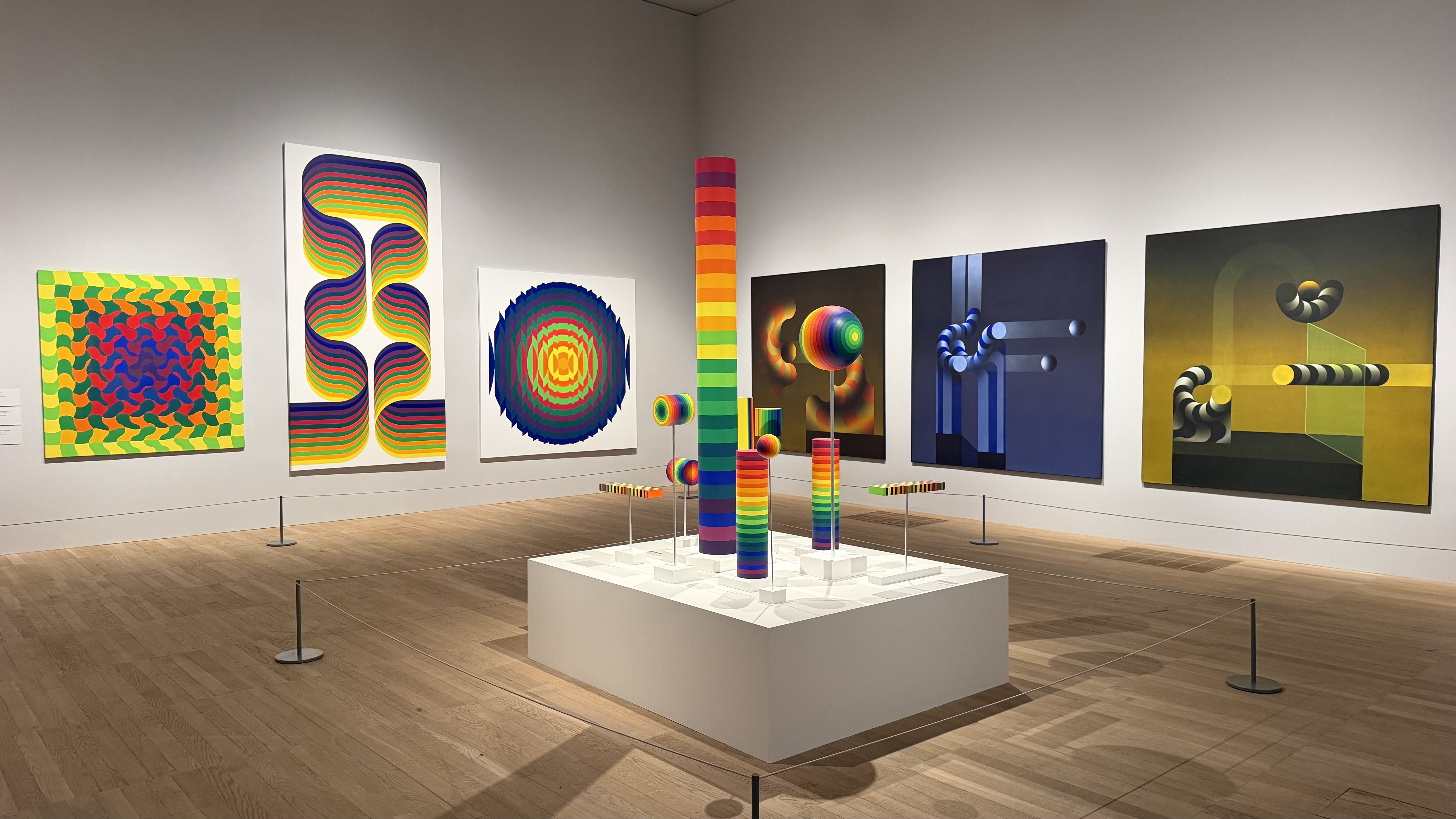
The exhibition begins with Le Parc’s early geometric investigations, where repeated forms and carefully calculated compositions produce subtle optical instabilities. Small shifts in pattern generate the sensation that paintings vibrate, rotate or dissolve before the viewer’s eyes. These works reveal an artist fascinated not by illusion itself, but by the mechanics of seeing.
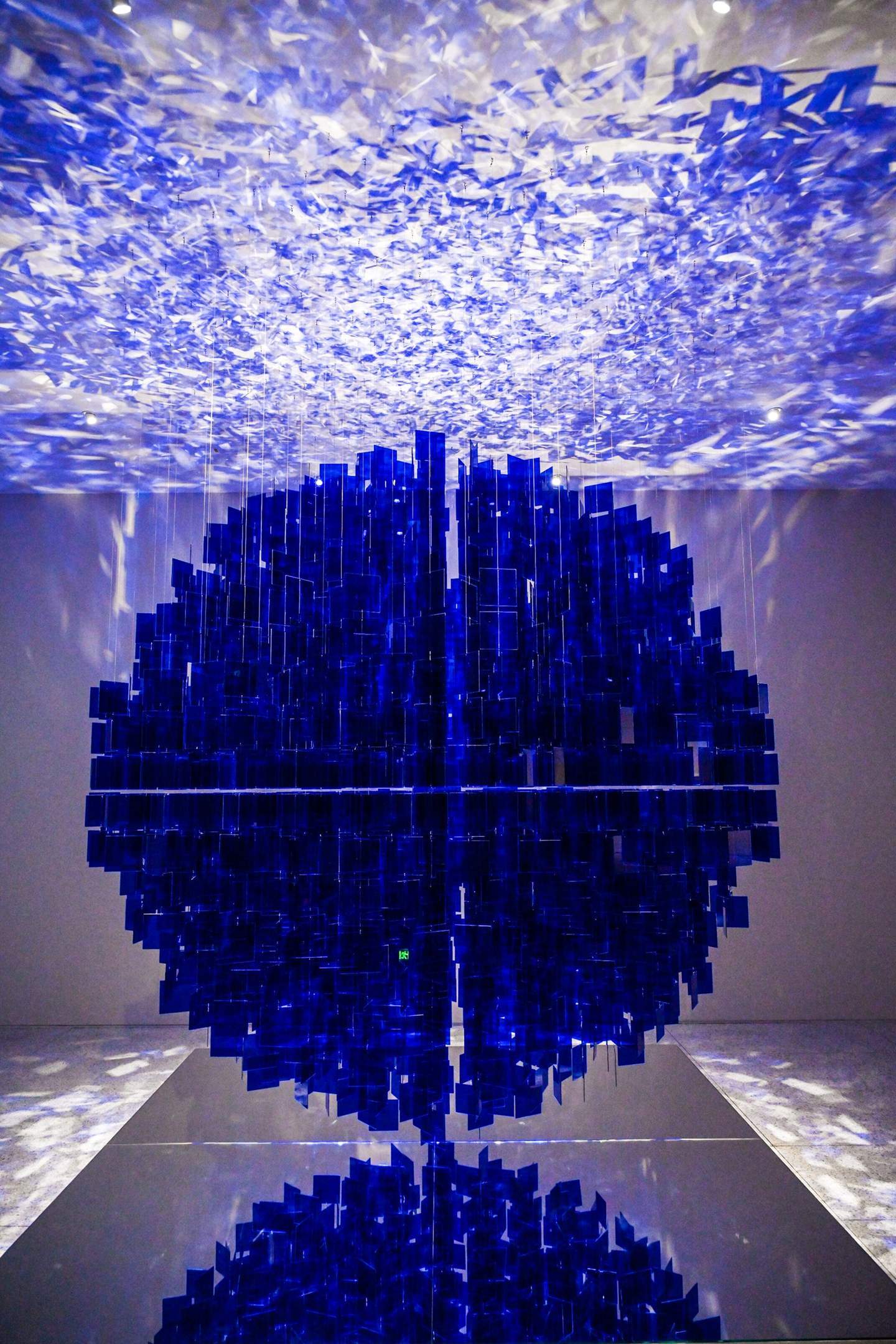
Light soon became his primary medium. Throughout the 1960s, Le Parc developed a groundbreaking series of kinetic sculptures that abandoned static composition in favour of continuous transformation. Suspended reflective elements, moving transparencies and projected light combine to create environments that constantly evolve as visitors move through them. Rather than presenting a fixed image, the works produce endless variations, making each encounter unique.
One of the exhibition’s greatest strengths lies in its emphasis on participation. Visitors are encouraged to walk around installations, activate mechanisms, manipulate objects and observe how their own presence alters the work. In pieces such as the celebrated Continual Light Mobiles, movement generated by air currents or human activity becomes part of the artwork itself. Elsewhere, interactive environments invite audiences to press buttons, rotate structures or physically enter installations, dissolving the traditional boundary between artwork and spectator.
This spirit of experimentation extends throughout Le Parc’s later production. His exploration of colour remains one of the defining characteristics of his practice, with carefully orchestrated chromatic sequences producing shifting visual rhythms that appear almost musical. Recent paintings demonstrate that, even after decades of innovation, his fascination with optical perception remains undiminished. Works from his Modulations and Alchemies series continue to investigate how simple geometric systems can generate extraordinary visual complexity.
Although Le Parc is frequently associated with kinetic and optical art, the exhibition makes clear that his contribution extends far beyond these labels. His work consistently challenges the authority of the museum itself, proposing a more democratic relationship between artist, artwork and audience. Rather than asking visitors to decode hidden meanings, Le Parc invites them to trust their own senses. The experience becomes the artwork.
The retrospective also arrives at a poignant moment. Following Julio Le Parc’s death earlier this year, the exhibition stands not only as a celebration of one of Latin America’s most influential artists, but also as a reminder of the remarkable relevance of his ideas. Long before the age of digital immersion, interactive installations and experiential art, Le Parc understood that the spectator would become an active participant in shaping artistic meaning.
Walking through the exhibition, one quickly realises that Le Parc’s greatest material has never been light or colour alone. It is perception itself. Every reflection, shadow and movement exists only because someone is there to activate it. Few artists have so fundamentally transformed the role of the viewer.
More than a retrospective, Julio Le Parc: Light. Colour. Action. demonstrates why his work continues to resonate across generations. Joyful without being superficial, playful without sacrificing intellectual depth, Le Parc reminds us that art can surprise, delight and provoke in equal measure. His legacy lies not only in what he created, but in how he taught us to look.
Julio Le Parc: Light. Colour. Action.
Tate Modern, London
11 June 2026 – 3 May 2027