From July 24, 2026, through February 1, 2027, Magazzino Italian Art in Cold Spring, New York, presents Bruna Esposito: In Light of Facts, a major solo exhibition dedicated to one of the most significant voices in contemporary Italian art.
Curated by Nicola Lucchi and installed in the Robert Olnick Pavilion, the exhibition brings together works never previously shown in the United States: an extensive selection from the series inconveniente (2014) and the installation Oltremare (sotto terra vulnerabili) (2006–2011).
Together, these works transform the pavilion into a layered environment in which ordinary materials become instruments of poetic, social and political reflection.
Light, movement and vulnerability
The exhibition title refers to the Italian expression alla luce dei fatti, meaning “in light of the facts.” In Esposito’s work, however, the phrase also acquires a literal dimension. Light becomes an active material, revealing aspects of reality that are frequently ignored or left at the margins.
Reflective surfaces, translucent plastics and moving images create an unstable visual landscape. Through objects associated with migration, commerce, rescue, protection and transit, Esposito addresses movement, labour, vulnerability, identity and the forms of adaptation that define contemporary life.
Her use of found and everyday materials recalls both the ready-made and the material vocabulary of Arte Povera. Yet rather than repeating these historical strategies, Esposito redirects them towards the conditions of the present. The objects retain their physical immediacy while carrying traces of collective experience, economic exchange and human passage.
The inconveniente series
Conceived in 2014, inconveniente takes its name from a word that can suggest difficulty, discomfort, obstruction or incompatibility.
Esposito does not treat these conditions simply as negative states. Instead, she approaches them as spaces of tension capable of producing unexpected forms and associations.
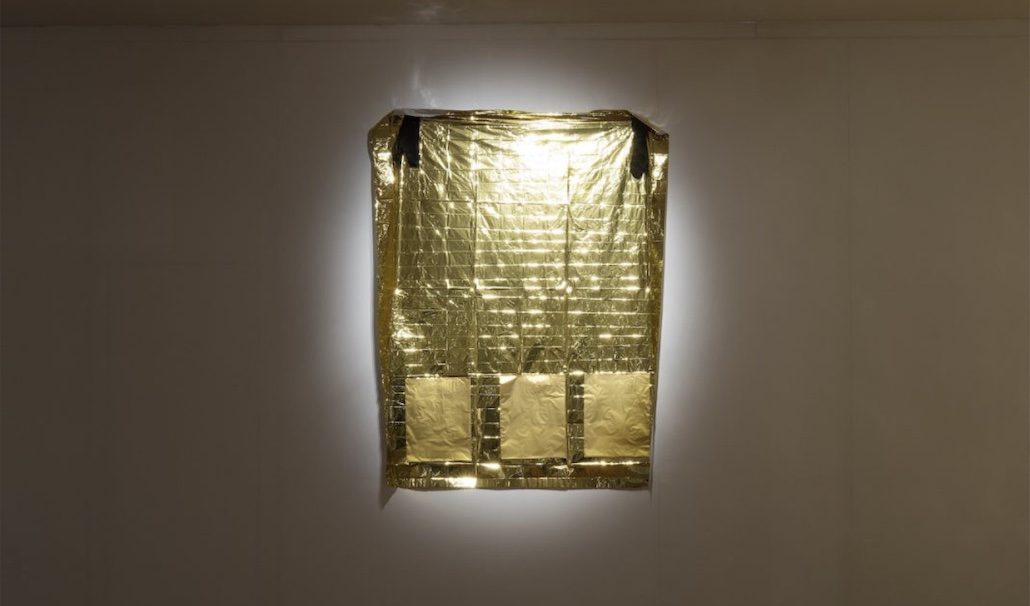
The works combine golden emergency blankets, market tables, steel bird spikes, cellophane and salvaged materials in precarious sculptural arrangements. They move between protection and hostility, seduction and austerity, familiarity and estrangement.
In Cielo, a translucent blue market table suspended on the wall is transformed into an image of the sky. In other works, horizontal sections of bird spikes and folded thermal blankets acquire the appearance of diagrams, borders or provisional landscapes.
The materials remain recognisable, but their function is displaced. Through this transformation, objects normally associated with commerce, public space or emergency become carriers of emotional and symbolic meaning.
Oltremare (sotto terra vulnerabili)
The second part of the exhibition centres on Oltremare (sotto terra vulnerabili), an installation presented in near darkness.
A small monitor placed directly on the floor shows a colourless, emblem-free flag reflecting and merging with the sea. Attached to a pole with a spear-shaped finial, the flag slowly descends beneath the surface until it brushes against the seabed.
Around the video, rice sacks serve as seats, while memorial candles emit a low red light. A suspended necklace of small silk birds—traditional Thai talismans associated with protection and good fortune—introduces a delicate counterpoint to the atmosphere of loss and vulnerability.
The installation evokes international trade, migration and the tragedies that have taken place at sea. At the same time, its elements suggest care, protection and solidarity.
The title Oltremare can be understood both as “beyond the sea” and as the name of the deep ultramarine blue traditionally associated with the ocean. This ambiguity expands the work’s reflection on identity, nationhood and the sea as a space that simultaneously separates and connects.
A continuing relationship with Magazzino
In Light of Facts marks the second major collaboration between Bruna Esposito and Magazzino Italian Art.
In 2021, the museum installed Altri Venti – Ostro (2020) in its grounds. The project was supported by Italian Council, the programme promoted by the Directorate-General for Contemporary Creativity of the Italian Ministry of Culture.
Esposito’s relationship with the institutions founded by Nancy Olnick and Giorgio Spanu began earlier, in 2013, when she created the site-specific work Out of the Blue for the Olnick Spanu Art Program in Garrison, New York.
For Olnick and Spanu, the new exhibition continues a long-standing friendship and reflects Magazzino’s mission to promote Italian artists whose work engages with the urgent questions of the present without abandoning the power of imagination.
Lucchi describes the exhibition as an exploration of the relationship between documentation and evocation. Esposito begins with materials and circumstances rooted in contemporary reality, but through her intervention they reveal the humanity—and the poetry—contained within the hardness of facts and things.
About Bruna Esposito
Born in Rome in 1960, Bruna Esposito has developed a sensory and multidisciplinary practice spanning sculpture, installation, performance, drawing, video, photography and collage.
Her work frequently incorporates smell, sound and touch, using simple materials to create poetic situations in which fragility becomes a form of strength.
Esposito participated in the Whitney Museum’s Independent Study Program in New York in 1985 and received the Golden Lion at the 1999 Venice Biennale as part of the Italian Pavilion exhibition dAPERTutto. Her work has been presented by institutions including MAXXI, Museo MADRE, Castello di Rivoli, the Galleria Nazionale d’Arte Moderna e Contemporanea, MUCIV–Museo delle Civiltà and Magazzino Italian Art.
The exhibition will be accompanied by a catalogue.
Bruna Esposito, Trittico (part.), 2014. Courtesy Wizard Gallery, Milano. Photo courtesy Fondazione Lercaro Bologna - Photo credit: © Antonio Maniscalco – Milan, Paris