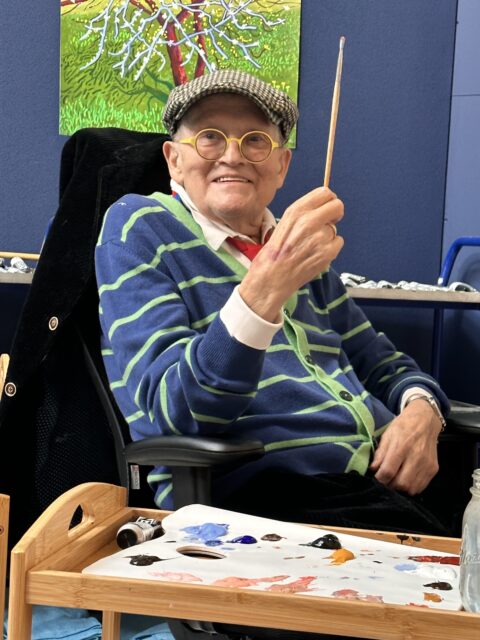
With the death of David Hockney, contemporary art loses one of its most beloved and influential figures. Across more than six decades, Hockney built a body of work that was instantly recognizable yet constantly evolving, bridging painting, photography, technology, and design with a curiosity that never seemed to diminish.
Few artists have shaped the visual imagination of the modern era as profoundly as Hockney. His swimming pools, Californian landscapes, intimate portraits, and vibrant interiors became part of a shared cultural vocabulary, transcending the boundaries of the art world to enter popular consciousness. Yet his significance extends far beyond his most iconic images.
Born in Bradford in 1937, Hockney emerged from post-war Britain to become one of the defining artists of his generation. Arriving in California in the 1960s, he found a visual language that would transform his career. The sharp sunlight, the geometry of modernist architecture, and the freedom of Los Angeles offered a dramatic contrast to the grey industrial landscapes of northern England. From this encounter emerged some of the most celebrated paintings of the twentieth century, works that captured not only a place but an entire idea of modern life.
What distinguished Hockney was his refusal to stand still. While many artists become associated with a single style, he remained restless throughout his life. He experimented with photography when painting dominated his peers, embraced digital technologies when others dismissed them, and continued to reinvent his practice well into his eighties. Whether working with oil paint, Polaroids, fax machines, iPads, or immersive installations, Hockney approached each medium with the same question: how do we truly see?
His influence reaches far beyond technique. At a time when representations of queer identity were largely absent from mainstream culture, Hockney painted his own life openly and unapologetically. Relationships, friendships, desire, and intimacy became central subjects in his work, helping to broaden the possibilities of representation in contemporary art.
Perhaps what made Hockney unique was his unwavering belief in the pleasure of looking. In an age increasingly dominated by screens, speed, and distraction, he championed observation. Trees in bloom, changing seasons, a friend sitting in a chair, sunlight moving across water—these ordinary moments became extraordinary through his attention. His paintings reminded viewers that beauty is not something distant or rare, but something constantly available to those willing to notice it.
In recent years, Hockney’s stature only continued to grow. Major retrospectives attracted record audiences around the world, while younger generations discovered his work through social media and digital platforms. Unlike many artists whose relevance belongs to a particular period, Hockney remained remarkably contemporary until the end, continuing to inspire painters, photographers, designers, architects, and filmmakers alike.
The art world will remember his extraordinary achievements, his exhibitions, and his record-breaking market success. But beyond institutions and auction results, David Hockney leaves behind something more enduring: a way of seeing. He taught us that curiosity is a creative force, that innovation does not require abandoning tradition, and that joy can be as intellectually powerful as critique.
His work transformed how we look at colour, space, landscape, and one another. More importantly, it reminded us that paying attention to the world remains one of the most radical acts an artist can perform.
David Hockney did not simply paint the world. He made us see it differently.
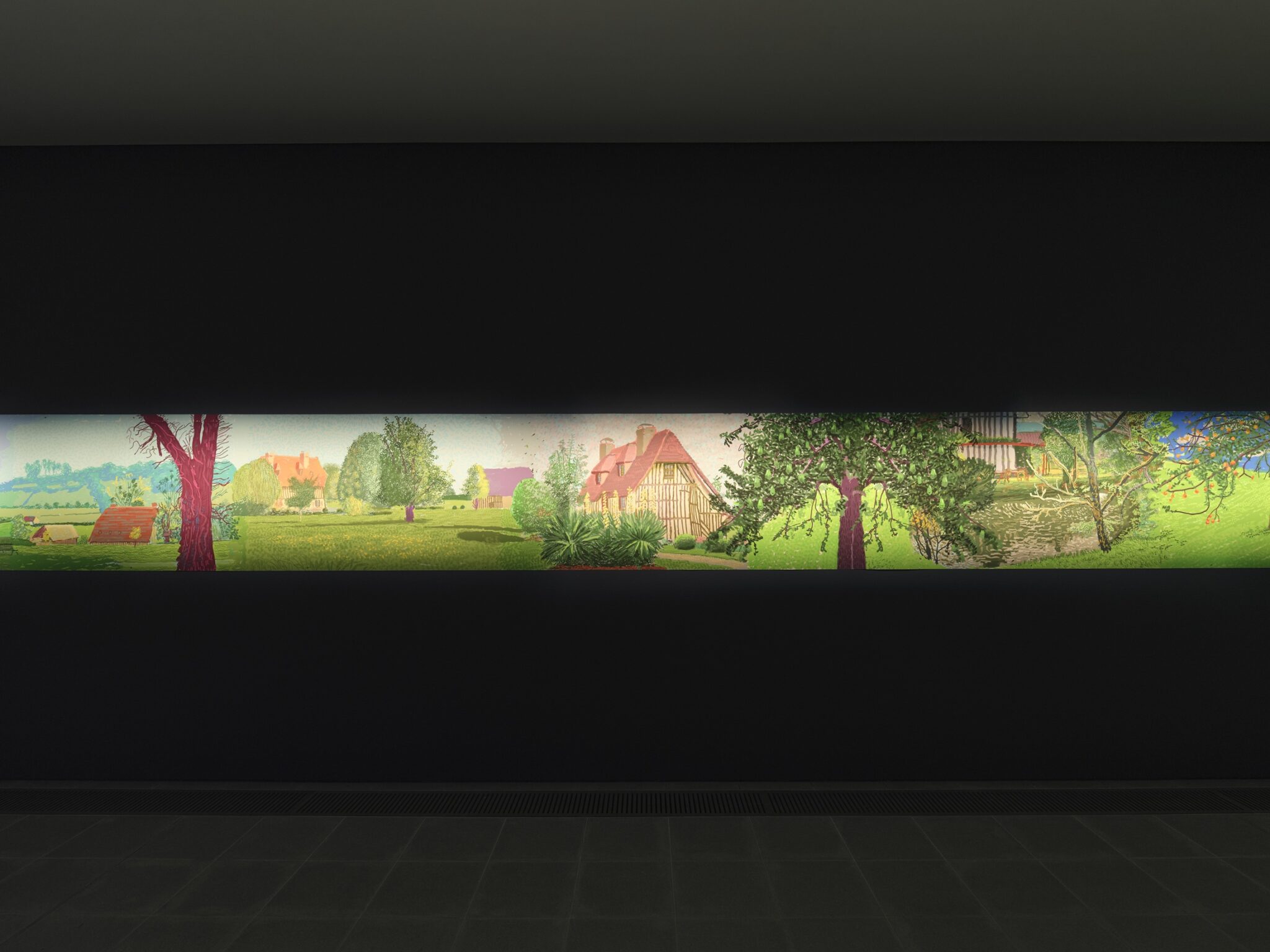
David Hockney: A Year in Normandie and Some Other Thoughts about Painting
Serpentine North Gallery
12 March - 23 August 2026
Free
One of the most influential artists of our time, David Hockney invites viewers to slow down and notice the extraordinary within the everyday in his first exhibition at Serpentine. Created specifically for this presentation, Hockney’s new paintings extend his lifelong fascination with the act of looking, affirming his belief that simple beauty is worth celebrating.
The exhibition is conceived in close collaboration with the artist and brings Hockney’s celebrated panoramic frieze A Year in Normandie to London for the first time. Inspired by the Bayeux Tapestry, this monumental work captures the changing seasons at the artist’s former studio in Normandy. In the context of the exhibition at Serpentine, it opens a dialogue with the surrounding nature of Kensington Gardens.