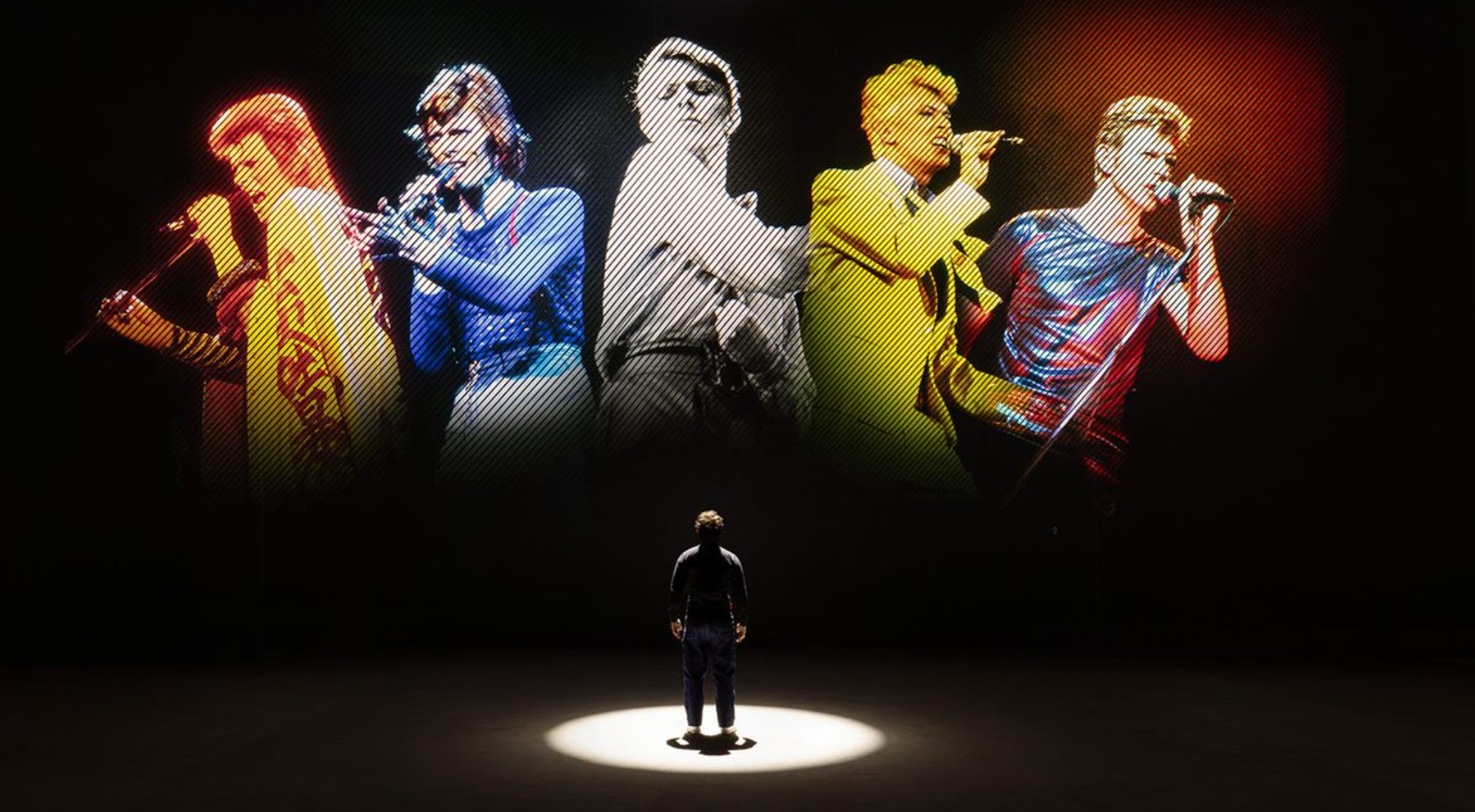
David Bowie spent much of his career convincing us he was from another planet.
There was Ziggy Stardust, the flame-haired alien who came to save rock and roll. Then Aladdin Sane, Halloween Jack and the impeccably dressed, unsettling Thin White Duke. Each incarnation arrived with its own wardrobe, mythology and attitude, only to disappear when Bowie decided it was time to become someone else.
For decades, we have celebrated this extraordinary capacity for reinvention. But perhaps we were so fascinated by the transformations that we forgot to pay attention to the person doing the transforming.
David Bowie: You’re Not Alone, the immersive exhibition at London's Lightroom in King's Cross, sets out to correct that oversight.
Rather than offering another chronological account of Bowie's career, the exhibition explores the ideas that occupied his imagination: creativity, identity, theatricality, spirituality and the peculiar business of being human.
Created in collaboration with the David Bowie Estate, the production draws on thousands of hours of archival material, including previously unseen concert footage, personal drawings, handwritten lyrics and interviews spanning five decades. Bowie himself provides the only narrative voice. There are no experts explaining his genius, no famous admirers telling us what he meant. Just Bowie, speaking for himself.
It is a particularly fitting approach for an artist who spent his life resisting easy explanations.
The experience unfolds across Lightroom's monumental, 360-degree projection space, where images and sound surround the audience. Performances from different decades appear on an architectural scale, from the early days of Space Oddity and Starman to the theatrical extravagance of Diamond Dogs and the haunting intensity of "Heroes".
Among the highlights is previously unseen footage from Bowie's 1978 Earl's Court performances, reconstructed from archival film. The elaborate stage design of the Diamond Dogs tour is also brought back to life, offering a glimpse of a spectacle that was as much theatre as rock concert.
But the exhibition's most interesting achievement may have little to do with its technology.
Bowie understood earlier than most that identity could be something constructed rather than inherited. He treated personality as an artistic medium, experimenting with gender, fashion, performance and public perception long before the language of fluid identity became part of everyday conversation.
Yet there is a paradox here. The man who appeared to have no fixed identity was also remarkably consistent in his curiosity. Across all the costumes and reinventions, Bowie remained interested in the same fundamental questions: Who are we? Why do we create? What happens when we refuse to become the person the world expects us to be?
In one memorable archival television interview from 1975, broadcaster Russell Harty struggles to pin Bowie down, eventually resorting to questions about his hair. It is an amusing reminder of how frequently the public conversation about Bowie became distracted by his appearance, while the more interesting ideas were happening somewhere beneath it.
His final album, Blackstar, released just two days before his death in January 2016, remains perhaps the ultimate expression of his belief that art could transform even the most personal experience into something universal.
And this is where You're Not Alone finds its emotional centre.
For all his theatrical otherness, Bowie was deeply concerned with the ordinary human experience of uncertainty. He understood that identity is rarely stable, that we are constantly becoming different versions of ourselves, and that creativity offers a way of making sense of the process.
Perhaps this is why his influence has extended so far beyond music. Bowie gave generations of outsiders permission to imagine themselves differently. Not necessarily to become rock stars, or dress like extraterrestrials, but to question the assumption that the person they were yesterday had to be the person they remained tomorrow.
Today, when reinvention has become an almost compulsory exercise in personal branding, there is something refreshing about revisiting an artist for whom transformation was driven by curiosity rather than self-optimisation. Bowie did not appear interested in becoming the best version of himself. He was interested in discovering how many versions might exist.
And perhaps that is the exhibition's most generous proposition.
After decades of looking at David Bowie as an alien, a visionary and an icon, we are invited to recognise him as one of us.
The costumes were extraordinary. The music was extraordinary. But the questions behind them were entirely human.
Maybe he was never quite as alien as we wanted him to be.
Lightroom, 12 Lewis Cubitt Square, King's Cross, London
Until 10 January 2027
Tickets from £25
lightroom.uk