From Koyo Kouoh’s posthumous Biennale to Dries Van Noten’s new foundation, a city-wide map of every exhibition worth your time between March and November.
Every two years, Venice stops being a city and starts being a question. For seven months in 2026, that question is being asked in a quieter register than usual. The 61st International Art Exhibition of La Biennale di Venezia opens on 9 May under the title In Minor Keys, a curatorial framework conceived by the Cameroonian curator Koyo Kouoh, who passed away in May 2025 — one year, almost to the day, before her exhibition opens. The Biennale will be realised exactly as she designed it, by the team she herself assembled. It is the first edition in the 131-year history of the institution to be staged posthumously, and the first ever led by an African woman.
Around that anchoring event, the city is hosting one of the most ambitious programmes of contemporary art exhibitions in its modern history. New foundations are opening — Dries Van Noten in a 15th-century palazzo on the Grand Canal, Anish Kapoor returning to Palazzo Manfrin, SMAC mounting two simultaneous eight-gallery surveys above Piazza San Marco. The Pinault Collection takes over Palazzo Grassi with two major solo shows. Ca’ Pesaro stages the first big Jenny Saville exhibition in Venice. Three first-time-ever national pavilions — Qatar, Sierra Leone, Somalia — debut in the Giardini, while seven countries enter the Biennale’s main exhibition for the first time. The Palazzo Fortuny finally gives Erwin Wurm his Italian moment. Parasol unit returns from a five-year hiatus.
What follows is your complete map. Use it as an itinerary, a reference list, or a magazine reader’s tour of what to see when you arrive.
The Headliner
61st Venice Biennale: In Minor Keys
The Biennale Arte 2026 opens on Saturday 9 May with previews from 6 to 8 May, and closes on 22 November. Koyo Kouoh (1967–2025), then Executive Director of Zeitz MOCAA in Cape Town and founder of RAW Material Company in Dakar, was appointed Artistic Director in November 2024 and had finalised the entire curatorial framework — 110 artists, catalogue, graphic identity, exhibition design — before her unexpected passing in May 2025. With her family’s full support, La Biennale is delivering the exhibition as she conceived it, realised by the team she assembled and known publicly as la squadra di Koyo Kouoh: advisors Gabe Beckhurst Feijoo, Marie Hélène Pereira and Rasha Salti, editor-in-chief Siddhartha Mitter, and assistant Rory Tsapayi.
In Minor Keys takes its title from a musical metaphor. Kouoh wrote of an exhibition that would refuse “orchestral bombast” in favour of quieter frequencies — the hum, the consolation, the granular signal. The Giardini and Arsenale have been reorganised to slow visitors down, with rest spaces threaded through the route and live processions of poets programmed across the run. The result, by all early accounts, is closer to a free-jazz ensemble than a thematic survey: 110 artists arranged around resonances and convergences rather than national or generational categories. In recognition of the circumstances, the Golden Lions for Lifetime Achievement will not be awarded this year, and the international jury — chaired by Solange Oliveira Farkas — is the first all-female jury in Biennale history.
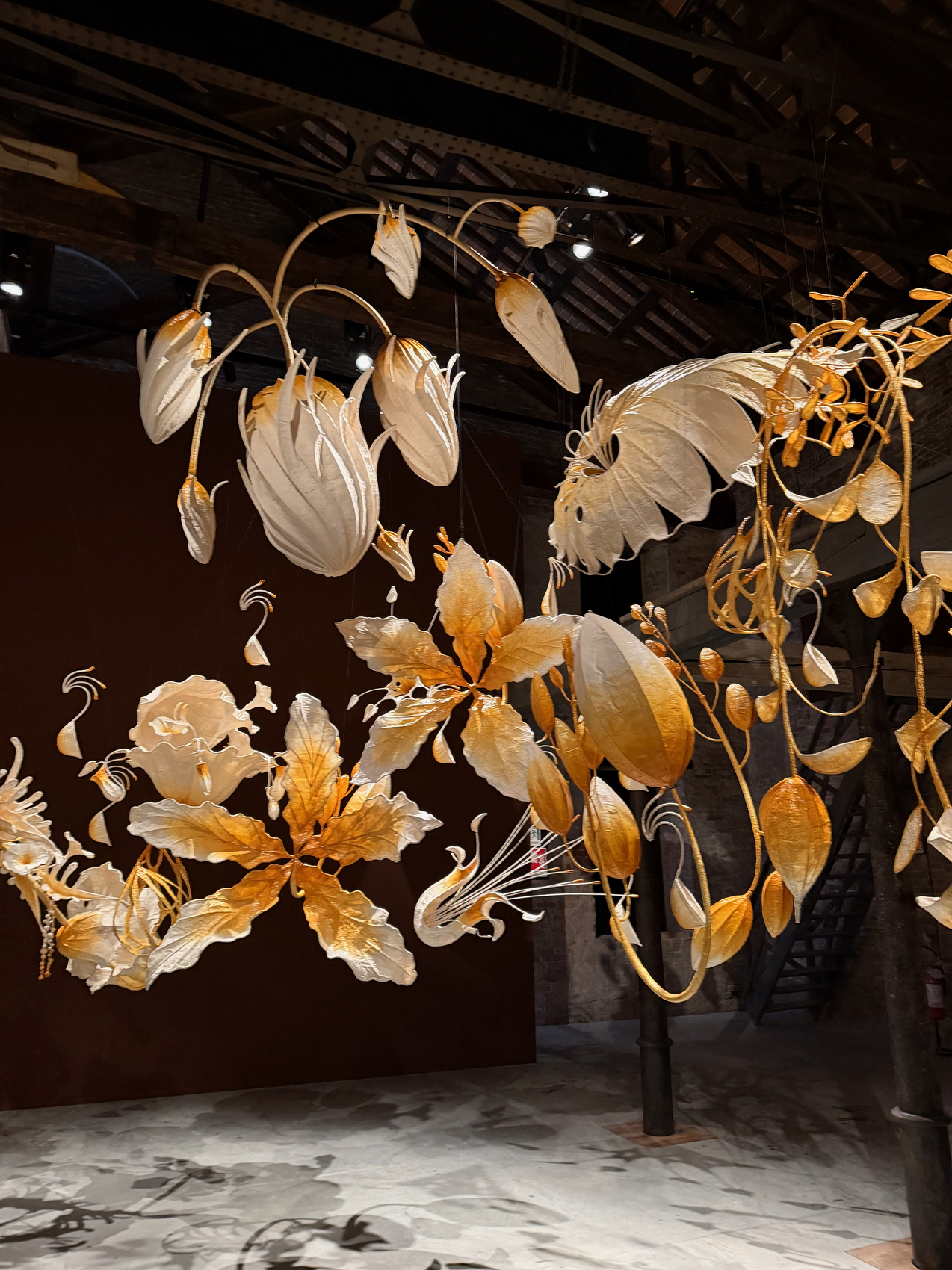
The emotional centre of the show is a monumental paper mural by Maria Magdalena Campos-Pons & Kamaal Malak, Anatomy of the Magnolia Tree for Koyo Kouoh & Toni Morrison, installed near the entrance of the Central Pavilion — the Biennale’s altar to its own absent curator. Other names already drawing attention: Otobong Nkanga, who has rewilded the Modernist columns of the Central Pavilion with brick and living plants; Nick Cave, Laurie Anderson, Kader Attia, Wangechi Mutu, Walid Raad, Alfredo Jaar, Tabita Rezaire, Tiona Nekkia McClodden, Sammy Baloji, Ebony G. Patterson, and the Senegalese artist Issa Samb (1945–2017), shown alongside the American artist Beverly Buchanan as guiding spirits of the exhibition in the Central Pavilion’s Chini Room.
The National Pavilions Everyone Is Talking About
Of the 99 national participations this year, a handful have already broken into the broader conversation. The Austrian Pavilion belongs to Florentina Holzinger, whose Seaworld Venice turns the building into part-aquarium, part-performance arena, with site-specific études staged across the lagoon under curator Nora-Swantje Almes. Qatar debuts with its first-ever national pavilion — a tent designed by Rirkrit Tiravanija on the future permanent pavilion’s footprint, with works by Tiravanija, Sophia Al Maria, Tarek Atoui, Alia Farid and Fadi Kattan, curated by Tom Eccles and Ruba Katrib. India returns after a seven-year absence with five artists working in clay, thread, bamboo and papier-mâché, curated by Amin Jaffer, featuring Sumakshi Singh’s Permanent Address — already one of the most photographed installations of the entire Biennale.
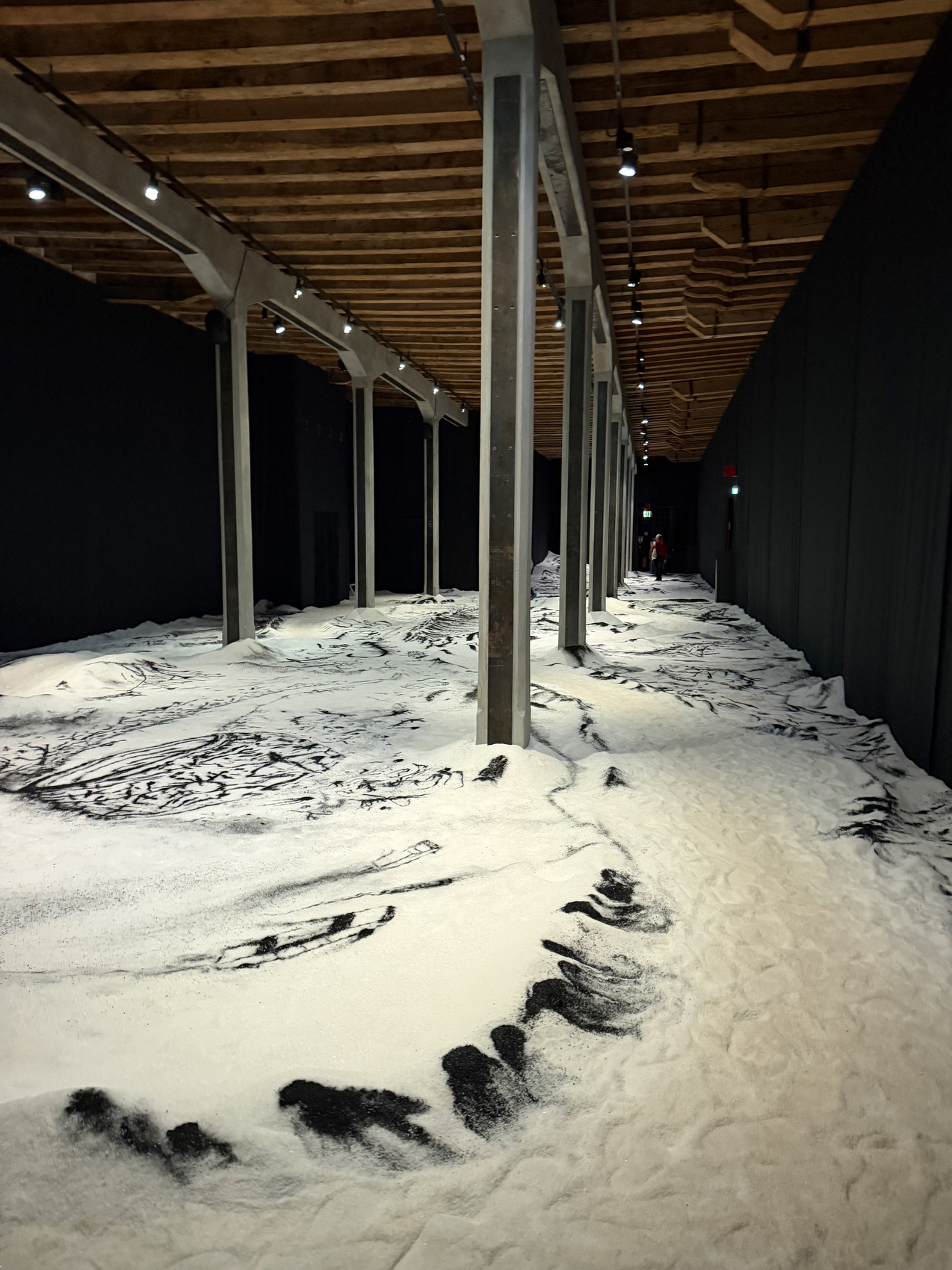
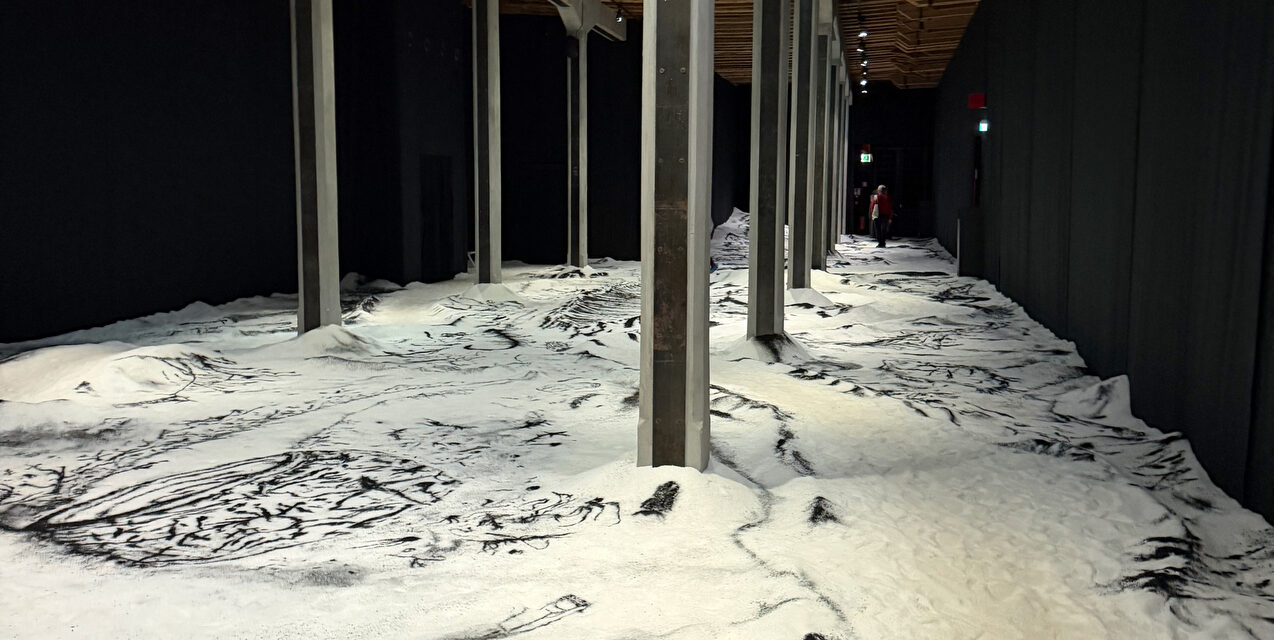
The United Arab Emirates stages Washwasha (whispers) at the Sale d’Armi with Mays Albaik, Jawad Al Malhi, Farah Al Qasimi, Alaa Edris, Lamya Gargash and Taus Makhacheva. Argentina hands its pavilion to Matías Duville, whose Monitor Yin Yang is a vast charcoal-and-salt floor drawing that visitors walk across — the work will be reshaped by their footsteps over six months. China’s Dream Stream, named after Shen Kuo’s eleventh-century Song Dynasty encyclopaedia, brings calligraphy by Wang Dongling, painting by Xu Jiang and film by Yang Fudong into the same space as live robotics. And Denmark’s Things to Come by Maja Malou Lyse, working with the collective DIS — the youngest artist ever to represent the country — builds a video and installation environment somewhere between fertility clinic, biotech showroom and adult-film set, drawing on a Cryos study on virtual stimuli and male fertility. It is the most controversial pavilion of the year.
Pinault Collection at Palazzo Grassi
The Pinault Collection mounts two solo shows that share a curator and a building but pull in radically different directions. Michael Armitage: The Promise of Change (29 March 2026 – 10 January 2027), curated by Jean-Marie Gallais with Hans-Ulrich Obrist on the catalogue, is the largest exhibition of the Pinault’s 2026 Venetian programme: around 45 paintings on Ugandan bark cloth (lubugo) and more than 100 works on paper, spread across both floors of the palazzo. At 42, the Kenyan-British painter is the youngest artist ever given the run of Palazzo Grassi.
On the upper floor, Amar Kanwar: Co-Travellers (29 March 2026 – 10 January 2027), also curated by Gallais, pairs two of Kanwar’s most important multimedia installations made twenty years apart: The Torn First Pages (2004–2008), on the long struggle for democracy in Myanmar, and The Peacock’s Graveyard (2023), his most recent major work — a 28-minute cycle of five short stories shown on seven semi-transparent screens in total darkness, now in the Pinault Collection. Together the two installations function as a chamber piece on testimony, archive and the politics of looking.
Major Museum & Foundation Solo Shows
Across the canal at Ca’ Pesaro, Jenny Saville (28 March – 22 November 2026) opens the artist’s first major exhibition in Venice — around 30 paintings spanning her career, curated by Elisabetta Barisoni with support from Gagosian, including seminal works like Hyphen (1999), Reverse (2002–03), Rosetta II (2005–06) and Byzantium (2018), plus new canvases — a Danae and a Venus and Adonis — made specifically as a tribute to Titian and the Venetian masters. In Cannaregio, Anish Kapoor opens his foundation’s Palazzo Manfrin for only the second time in history (20 April – 9 August 2026), with around 100 architectural models documenting 50 years of practice alongside new installations including an eight-metre suspended At the Edge of the World, a new mirror work, and a fresh selection of Vantablack sculptures.
At the Peggy Guggenheim Collection, Peggy Guggenheim in London: The Making of a Collector (25 April – 19 October 2026) is the first museum exhibition ever dedicated to Peggy’s London years and her first gallery, Guggenheim Jeune (1938–39), bringing together works by Kandinsky, Mondrian, Hepworth, Moore, Taeuber-Arp, Dalí, Eileen Agar and Rita Kernn-Larsen. Curated by Gražina Subelytė and Simon Grant, the show travels onward to the Royal Academy in London (autumn 2026) and the Guggenheim New York (spring 2027). Across town at Palazzo Fortuny, Erwin Wurm: Dreamers (6 May – 22 November 2026), curated by Cristina Da Roit and Elisabetta Barisoni, is the Austrian sculptor’s first comprehensive monograph in Italy — the One Minute Sculptures, Fat Cars and Fat Houses in dialogue with Mariano Fortuny’s textile-rich rooms.
On the Isola di San Giorgio Maggiore, David Salle: Painting in the Present Tense (6 May – 27 September 2026) at Palazzo Cini puts an AI model trained on Salle’s Tapestry Paintings (1990–92) into conversation with the originals — a deliberately provocative meditation on Salle’s thesis that “everything in painting exists in the present tense.”
SMAC: Two Eight-Gallery Surveys Above Piazza San Marco
The San Marco Art Centre stages what is effectively the season’s most ambitious double bill, across the upper floors of the Procuratie themselves. Alighiero Boetti (7 May – 22 November 2026), curated by Elena Geuna with support from Ben Brown Fine Arts, gathers around 100 works tracing 25 years of the Italian post-war master, from his Arte Povera origins through the Afghan-embroidered Mappe and the Tutto canvases. Two days later, Lee Ufan (9 May – 22 November 2026) opens as an official Collateral Event of the Biennale, organised by Dia Art Foundation and curated by Jessica Morgan in close partnership with the artist. Marking Lee’s 90th birthday, the show traces his painterly journey from the late 1960s to a new site-specific commission, alongside seminal sculptural works including Relatum (formerly Iron Field) (1969/2019) and a new Mirror Road made from polished steel plates that visitors walk across.
New Foundations & Major Private Spaces
The newest arrival on the Grand Canal is the Fondazione Dries Van Noten at Palazzo Pisani Moretta, opening on 25 April with its inaugural exhibition The Only True Protest Is Beauty (25 April – 4 October 2026). Founded by the Belgian designer and his partner Patrick Vangheluwe after Van Noten’s exit from his eponymous fashion house in 2024, the foundation occupies a 15th-century palazzo with Tiepolo ceilings and a 24-candle chandelier. The inaugural show, curated by Van Noten with Geert Bruloot, deploys more than 200 works across 20 rooms on three floors — Comme des Garçons, Christian Lacroix, Misha Kahn, Joris Laarman, Joseph Arzoumanov, Kate MccGwire, Joyce J. Scott, Ettore Sottsass, Hubert Duprat and dozens more — in a sustained argument for craftsmanship as a living cross-disciplinary language.
In Cannaregio, Aura at AMA Venezia (5 May – 22 November 2026) draws entirely from Belgian collector Laurent Asscher’s collection — a new Ed Ruscha commission for the space, a live work by Tino Sehgal, plus Arthur Jafa, Charles Ray, Christopher Wool, Richard Serra, Laura Owens and Jenny Saville. Across the canal in Dorsoduro, Sanlorenzo Arts opens its new Venetian project Casa Sanlorenzo (6 May – 30 June 2026) with Waves, curated by Sergio Risaliti and Cristiano Seganfreddo, pairing modern masters Calder, Fontana, Melotti and Cragg with younger voices including Christine Safa.
Collateral Events to Add to Your Route
The Fondazione Prada returns to Ca’ Corner della Regina with Helter Skelter: Arthur Jafa and Richard Prince (9 May – 23 November 2026), curated by Nancy Spector — the first time the two American image-scavengers have ever been shown together. More than 50 works across photography, video, installation, sculpture and painting unfold across the ground floor and piano nobile, alongside a collaboratively conceived zine made from images the artists exchanged during the process of building the show.
At Palazzo Franchetti, the Parasol unit foundation returns to Venice after a five-year hiatus with Turandot: To the Daughters of the East (9 May – 31 October 2026), an officially recognised Collateral Event curated by Dr Ziba Ardalan. Eleven women artists from Central and West Asia — Lida Abdul, Hera Büyüktaşcıyan, Daria Kim, Tala Madani, Afruz Amighi, Saodat Ismailova, Nazira Karimi, Huma Bhabha, Mona Hatoum, Farideh Lashai and Madina Joldybek — reclaim the figure of Turandot on her original Persian ground, in a year that also marks the centenary of Puccini’s opera.
And in Dorsoduro, the Victor Pinchuk Foundation and the PinchukArtCentre stage Still Joy — From Ukraine into the World (9 May – 1 August 2026) at the Palazzo Contarini Polignac. Twenty artists, the majority Ukrainian, anchor the exhibition around testimonies from a former marine and prisoner of war, Hlib Stryzhko, and the conflict journalist Nataliya Gumenyuk. Joy framed as a vital force and a radical act of humanity — in the fourth year of full-scale war.
Commercial Galleries Worth the Detour
At Victoria Miro Venice (5 May – 4 July 2026), the British painter Flora Yukhnovich opens Egg, a tightly conceived show of new paintings installed against a site-specific wall painting made on location, drawing on creation myths and fairy tales — the gap between what stories try to explain and what lived experience actually feels like.
The Complete List — Where to See What
A clean reference list of every exhibition covered above, organised by opening date.
JENNY SAVILLE · Ca’ Pesaro · Santa Croce · 28 Mar – 22 Nov 2026
AMAR KANWAR: CO-TRAVELLERS · Palazzo Grassi · San Marco · 29 Mar 2026 – 10 Jan 2027
MICHAEL ARMITAGE: THE PROMISE OF CHANGE · Palazzo Grassi · San Marco · 29 Mar 2026 – 10 Jan 2027
ANISH KAPOOR · Palazzo Venier Manfrin · Cannaregio · 20 Apr – 9 Aug 2026
FONDAZIONE DRIES VAN NOTEN: THE ONLY TRUE PROTEST IS BEAUTY · Palazzo Pisani Moretta · San Polo · 25 Apr – 4 Oct 2026
PEGGY GUGGENHEIM IN LONDON · Peggy Guggenheim Collection · Dorsoduro · 25 Apr – 19 Oct 2026
FLORA YUKHNOVICH: EGG · Victoria Miro Venice · San Marco · 5 May – 4 Jul 2026
AURA · AMA Venezia · Cannaregio · 5 May – 22 Nov 2026
DAVID SALLE: PAINTING IN THE PRESENT TENSE · Fondazione Giorgio Cini · San Giorgio Maggiore · 6 May – 27 Sep 2026
WAVES · Casa Sanlorenzo · Dorsoduro · 6 May – 30 Jun 2026
ERWIN WURM: DREAMERS · Palazzo Fortuny · San Marco · 6 May – 22 Nov 2026
ALIGHIERO BOETTI · SMAC San Marco Art Centre · San Marco · 7 May – 22 Nov 2026
61ST VENICE BIENNALE: IN MINOR KEYS · Giardini & Arsenale · Castello · 9 May – 22 Nov 2026
LEE UFAN · SMAC San Marco Art Centre · San Marco · 9 May – 22 Nov 2026
STILL JOY — FROM UKRAINE INTO THE WORLD · Palazzo Contarini Polignac · Dorsoduro · 9 May – 1 Aug 2026
HELTER SKELTER: ARTHUR JAFA AND RICHARD PRINCE · Fondazione Prada · Santa Croce · 9 May – 23 Nov 2026
TURANDOT: TO THE DAUGHTERS OF THE EAST · Palazzo Franchetti · San Marco · 9 May – 31 Oct 2026
How to Plan Your Visit
Allow at least three full days for the Giardini and the Arsenale themselves, plus another two to four days for the city-wide pavilions and institutional shows. The most efficient way to cover Venice is by sestiere. A San Marco day pairs SMAC’s two surveys with Palazzo Fortuny, Palazzo Franchetti, Palazzo Grassi and Victoria Miro. A Dorsoduro day takes in Peggy Guggenheim, Punta della Dogana, Palazzo Cini, Casa Sanlorenzo and Palazzo Contarini Polignac. Cannaregio gives you Palazzo Manfrin and AMA Venezia, plus the Jewish Ghetto if time allows. The Santa Croce / San Polo route runs Ca’ Pesaro, Fondazione Prada and Fondazione Dries Van Noten. Castello — the Giardini and Arsenale — deserves its own day or two.
Most institutions open 10am–6pm and close on Tuesdays; La Biennale’s main venues open 11am–7pm and close on Mondays except on a handful of designated open dates. Combined tickets are available for the Pinault Collection (Palazzo Grassi + Punta della Dogana) and for MUVE (Ca’ Pesaro and Palazzo Fortuny among others). Press accreditation for the main Biennale runs through labiennale.org; each foundation manages its own press office.
Venice has rarely been this dense with serious work. Plan accordingly.