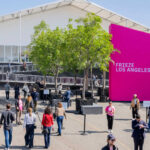
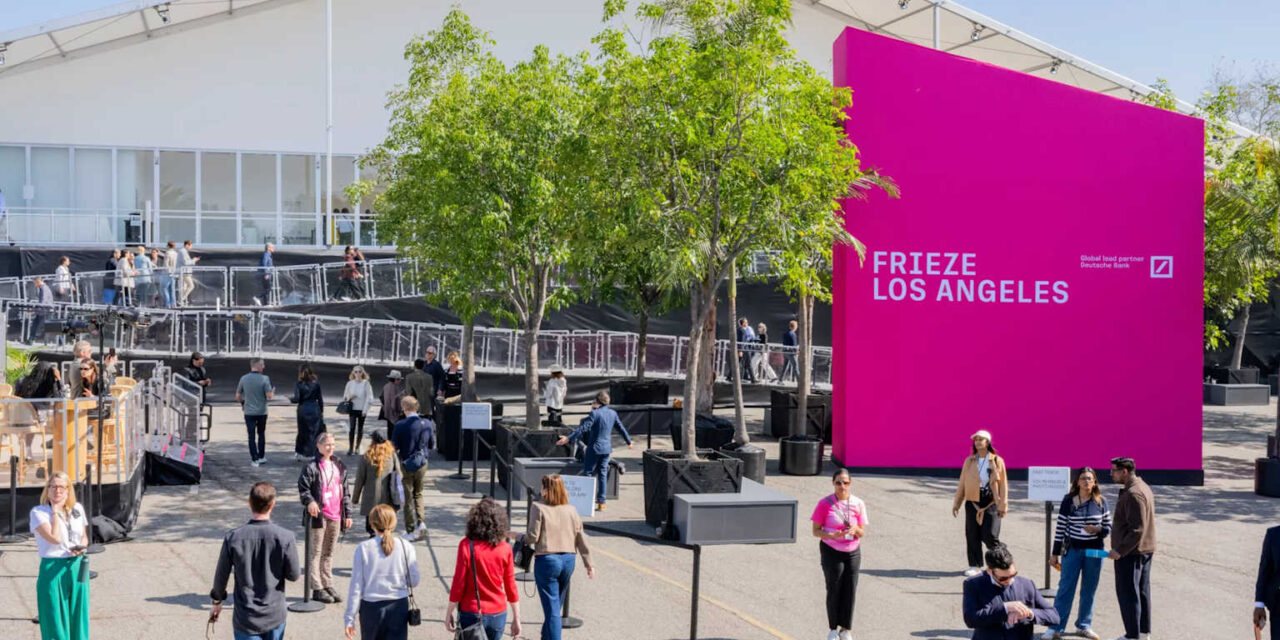
Frieze Los Angeles 2026 unfolded with a notable sense of restraint, as if the fair had finally aligned itself with the tempo of the city it inhabits. Held at the Santa Monica Airport from February 26 through March 1, the seventh edition convened more than 100 galleries from 24 countries and welcomed over 32,000 visitors from more than 45 countries, with representatives from 160 museums and institutions in attendance. Blue-chip galleries favored tightly edited presentations over spectacle, and the market followed suit: early sales were solid, with multiple seven-figure placements, but the dominant rhythm was steady and deliberate. Collectors moved with discernment, gravitating toward works with institutional weight and material clarity rather than speculative hype. Painting remained central, though often in quieter, process-oriented forms, reflecting a broader recalibration across the fair.
The week’s headline transaction came from David Zwirner, which placed a mixed-media work by Njideka Akunyili Crosby for $2.8 million to a European foundation, alongside a Lynette Yiadom-Boakye painting for $1.5 million and works on paper by Lisa Yuskavage at $180,000 and $280,000. Thaddaeus Ropac sold a Georg Baselitz painting for €1 million and an Alex Katz for $700,000, alongside a David Salle for $280,000 and a Liza Lou for $225,000. Pace placed a James Turrell installation for $950,000, alongside works by Jean Dubuffet and Emily Kam Kngwarray; Almine Rech reported a Ewa Juszkiewicz painting in the $800,000–$850,000 range; White Cube placed three Antony Gormley sculptures in the £500,000–£800,000 range. Gagosian reported six- and seven-figure placements of works by Ed Ruscha, Frank Gehry, Alex Israel, Jonas Wood, and Mary Weatherford. Hauser & Wirth sold out its booth of new paintings by Conny Maier — Dust Bowl — on opening day, with large canvases at $125,000 and a smaller work at $25,000.
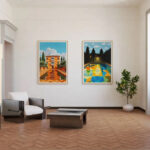
Among the most compelling debuts was El Apartamento, participating in Frieze LA for the first time with a solo presentation of Miki Leal. The booth brought together a series of intimate works on paper — acrylic and watercolor compositions that weave together references from design, architecture, music, and everyday visual culture. Titles such as A mi madre, linda jugadora… (2026), Casas en Japón. Volumen I (2025), and Un cóctel para los Eames (2025) signaled Leal’s associative language: a playful yet precise layering of motifs that collapses high and low cultural registers. Installed with clarity and breathing space, the presentation allowed the works’ rhythmic compositions and chromatic sensitivity to unfold gradually, offering a contemplative counterpoint to the fair’s accelerated environment. Director Christian Gundin reported a strong preview day with significant sales and confirmed the gallery’s intention to return.
Depth in the mid-market and emerging tiers proved equally telling. The Focus section, curated by Essence Harden, saw several sold-out booths, including Sea View’s sculptures by Zenobia Lee, PATRON’s five works by Jamal Cyrus for $20,000 to $40,000, and Dreamsong’s nine works by Tamar Ettun in the range of $2,600 to $20,000. Frieze’s dedicated booth for the 2026 Frieze Impact Prize winner Napoles Marty also sold out in full. Institutional engagement was pronounced: the Mohn Art Collective (MAC3) — a joint initiative between the Hammer, LACMA, and MOCA — acquired works by Clarissa Tossin from kaufmann repetto, Zenobia Lee from Sea View and Sharif Farrag from Jeffrey Deitch, while the California African American Museum acquired works by Jessica Taylor Bellamy and Zenobia Lee.
Beyond the tent, Los Angeles asserted itself as an equal protagonist. Hauser & Wirth’s Downtown LA campus drew sustained attention with Destiny Is a Rose: The Eileen Harris Norton Collection (24 February–16 August 2026), a survey of the patron’s decades-long engagement with artists including Mark Bradford, David Hammons, Kerry James Marshall, Lorraine O’Grady, Alison Saar, and Alma Thomas. Christina Quarles’s The Ground Glows Black, responding to her displacement during the 2025 wildfires, opened concurrently. At David Kordansky Gallery, Sayre Gomez’s Precious Moments extended through Frieze week, anchoring the gallery’s commitment to documenting LA’s urban fabric. Night Gallery activated its program across multiple spaces, reinforcing its role as a key interlocutor in the city’s evolving scene. The week’s broader register was visibly shaped by the aftermath of the 2025 fires, with acquisition funds and exhibition programming foregrounding the local creative community in tangible ways.
What emerged across the week was not a singular narrative but a distributed one. Frieze LA no longer attempts to dominate the city; instead, it operates within it — one node among many. The fair’s maturity lies precisely here: in its willingness to reflect Los Angeles as it is — decentralized, layered, and resistant to easy conclusions — while still delivering a market that, if more measured than spectacular, feels increasingly grounded.